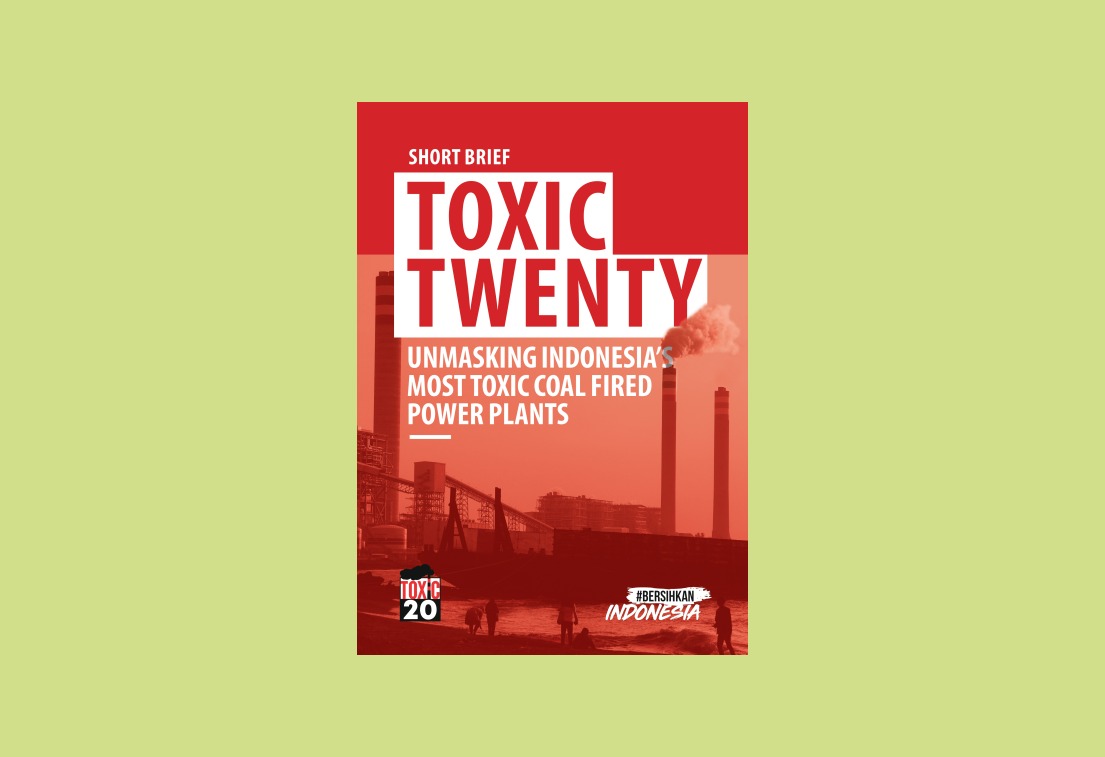
Jakarta, November 4th, 2025 – Indonesia risks 156,000 premature deaths and USD 109 billion (IDR 1.813 quadrillion) in economic losses from the cumulative operation of the country’s 20 most dangerous coal-fired power plants (CFPPs) through 2050, according to a new report released today by the Centre for Research on Energy and Clean Air (CREA), Celios, and Trend Asia.
The report, titled “Toxic Twenty: Unmasking Indonesia’s Most Toxic Coal Fired Power Plants,” highlights the severe health, environmental, and economic impacts of continued coal dependence. It comes one year into President Prabowo Subianto’s administration, which has yet to take concrete steps toward his stated goal of retiring coal plants and achieving 100% renewable energy within the next decade.
“Jakarta’s rising cases of acute respiratory infections are not isolated incidents—they’re linked to transboundary pollution from coal-fired power plants surrounding the capital,” said Katherine Hasan, Analyst at CREA. “Indonesia’s dependence on coal continues to endanger public health, strain the economy, and undermine its own climate and energy transition targets.”
Massive Health and Economic Toll
The report assesses pollution dispersion and health outcomes associated with coal combustion, including premature births, low birth weight, childhood asthma, stroke, work absences, and premature deaths. The analysis covers both historical impacts (2000–2025) and projected future effects (2026–2050).
Even with the Energy Ministry’s Regulation No. 10/2025 outlining a coal retirement roadmap, the study warns that its implementation remains optional and financially dependent, rather than mandatory for climate and community protection. The current energy mix—still heavily reliant on coal—is delaying Indonesia’s clean energy transition.
The report estimates that the top 20 CFPPs in the Sumatra, Java, and Bali grids could cause annual economic losses of IDR 52.4 trillion and reduce public income by IDR 48.4 trillion. Moreover, pollution-related damage to agriculture, plantations, and fisheries could lead to the loss of 1.45 million jobs, contradicting the Prabowo-Gibran government’s promise to create 19 million new jobs.
“Coal-fired power plants are eroding the livelihoods of farmers, fishers, and plantation workers,” said Atina Rizqiana, Researcher at Celios. “While the government promises job creation, coal pollution is destroying the economic foundation of communities across Indonesia.”
Foreign Investment Driving the Crisis
The Toxic Twenty report also identifies foreign financiers behind Indonesia’s most hazardous coal plants. Japan and China are the largest backers, followed by Indonesia and the United Kingdom. In terms of capacity, Japan leads with investments in projects totaling 63,328 MW, followed by China (18,815 MW), Indonesia (17,330 MW), and the UK (10,325 MW).
“Early retirement of coal plants is not only a public health imperative—it’s a financial one,” said Novita Indri Pratiwi, Energy Campaigner at Trend Asia. “Continuing to finance coal is a false solution. Governments and financiers, particularly Japan and China, must stop funding coal projects and support a just, sustainable energy transition instead.”
Despite invitations, the Ministry of Energy and Mineral Resources did not attend the launch or provide comments on the report. The Ministry plays a central role in planning Indonesia’s coal phase-out strategy.
Complete report